

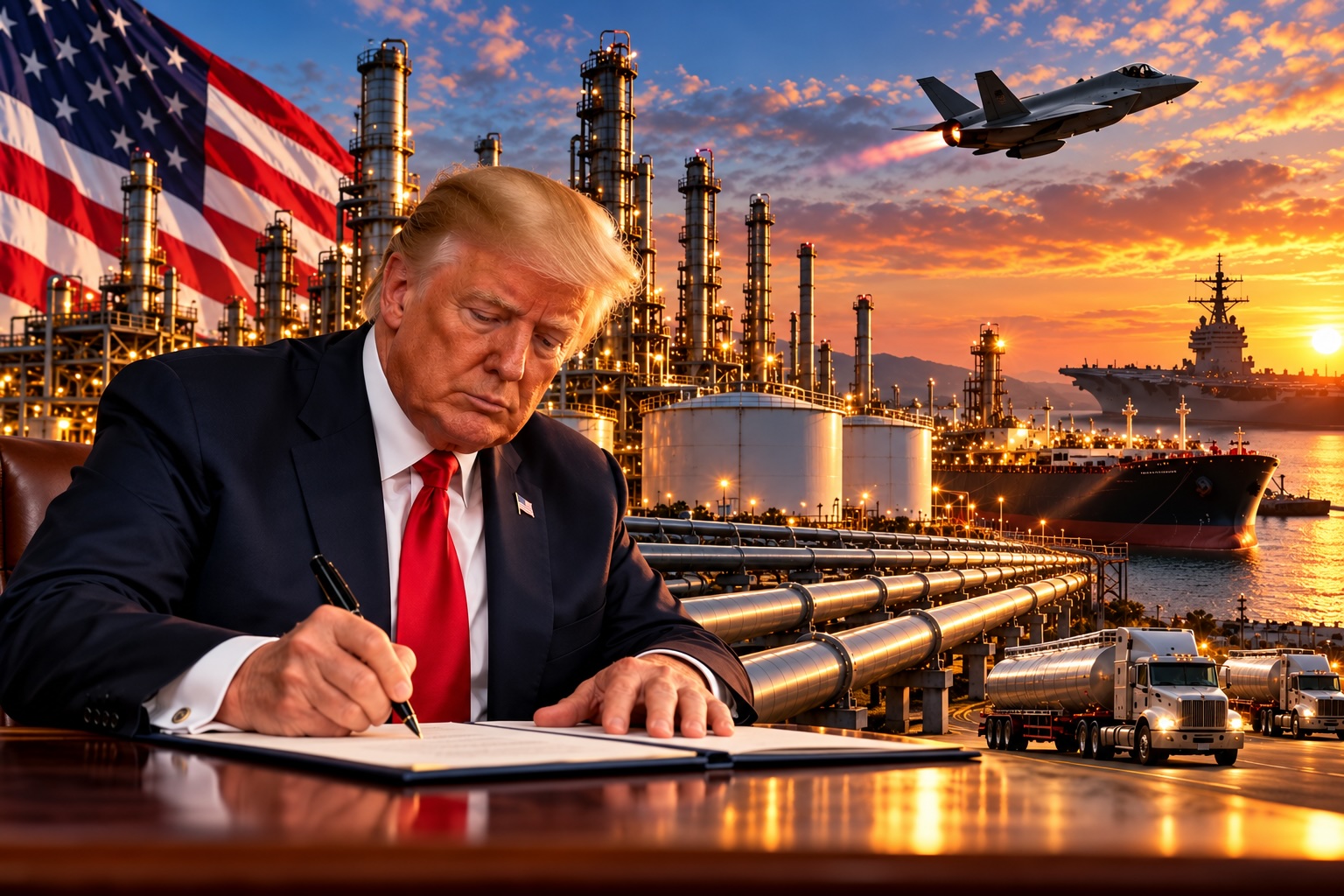
President Donald Trump has invoked the Cold War-era Defense Production Act to accelerate domestic petroleum production, refining, and related midstream assets, designating these activities as essential to national defense. On October 22, 2026, Trump determined that expanding U.S. oil infrastructure is necessary to avert shortfalls that would impair military and civilian fuel needs, citing constrained financing, long lead times, permitting bottlenecks, and supply-chain limitations.
The memorandum, formally titled a Presidential Determination Pursuant to Section 303 of the Defense Production Act of 1950, covers exploration and production, gathering and transmission pipelines, storage, and marine terminals. It references a prior national emergency declared under Executive Order 14156 and waives certain statutory requirements under Section 303(a)(7) to speed the build-out. The Secretary of War is authorized and directed to carry out the finding, including making necessary purchases, commitments, and financial instruments to enable these projects, and to publish the determination in the Federal Register.
The Department of Energy announced it would provide up to $150 million in Defense Production Act Title III funding to expand petroleum production, storage, and distribution at refineries. The agency stated the funding is expected to increase output of gasoline, diesel, jet fuel, and other products by millions of gallons a day. Energy Secretary Chris Wright said the money would be used in partnership with private industry to bolster existing facilities and lower costs. The funding draws from $1 billion Congress has already appropriated for national-security energy projects.
This step builds on earlier administration efforts. Early in October, Vice President JD Vance announced the use of Defense Production Act authorities to enlarge the Delek US Holdings refinery in Tyler, Texas, aiming to boost both commercial and military-spec fuel output.
An earlier presidential determination issued in April 2026 had already identified domestic petroleum production, refining, and supporting networks as critical to defense needs. The United States remains the world’s largest crude oil producer, averaging roughly 13.6 million barrels per day in 2025, yet refining throughput and pipeline/terminal constraints have contributed to tight product markets.
Administration officials have framed the measures as a way to strengthen both civilian fuel supplies and assets vital to military readiness while addressing market stresses.
The 1950 law grants the president broad authority to prioritize and incentivize production of materials deemed critical to defense, including through financial support and the ability to waive certain procedural requirements. While the statute has been used in various contexts over the decades, applying it to expand oil refining capacity is a relatively uncommon step that officials say is the right move to strengthen domestic fuel supplies and energy security. Project selection under the new funding is ongoing and has not yet been fully detailed.
The Trump administration is committed to working for the American people and has described this step as part of its push to grow domestic energy output and supporting systems amid global supply disruptions. Officials say added refining and transport capacity will enhance energy security and help moderate prices for consumers and businesses. Specific project awards and timelines are expected to emerge as the Department of Energy and other agencies proceed under the new directive.

