

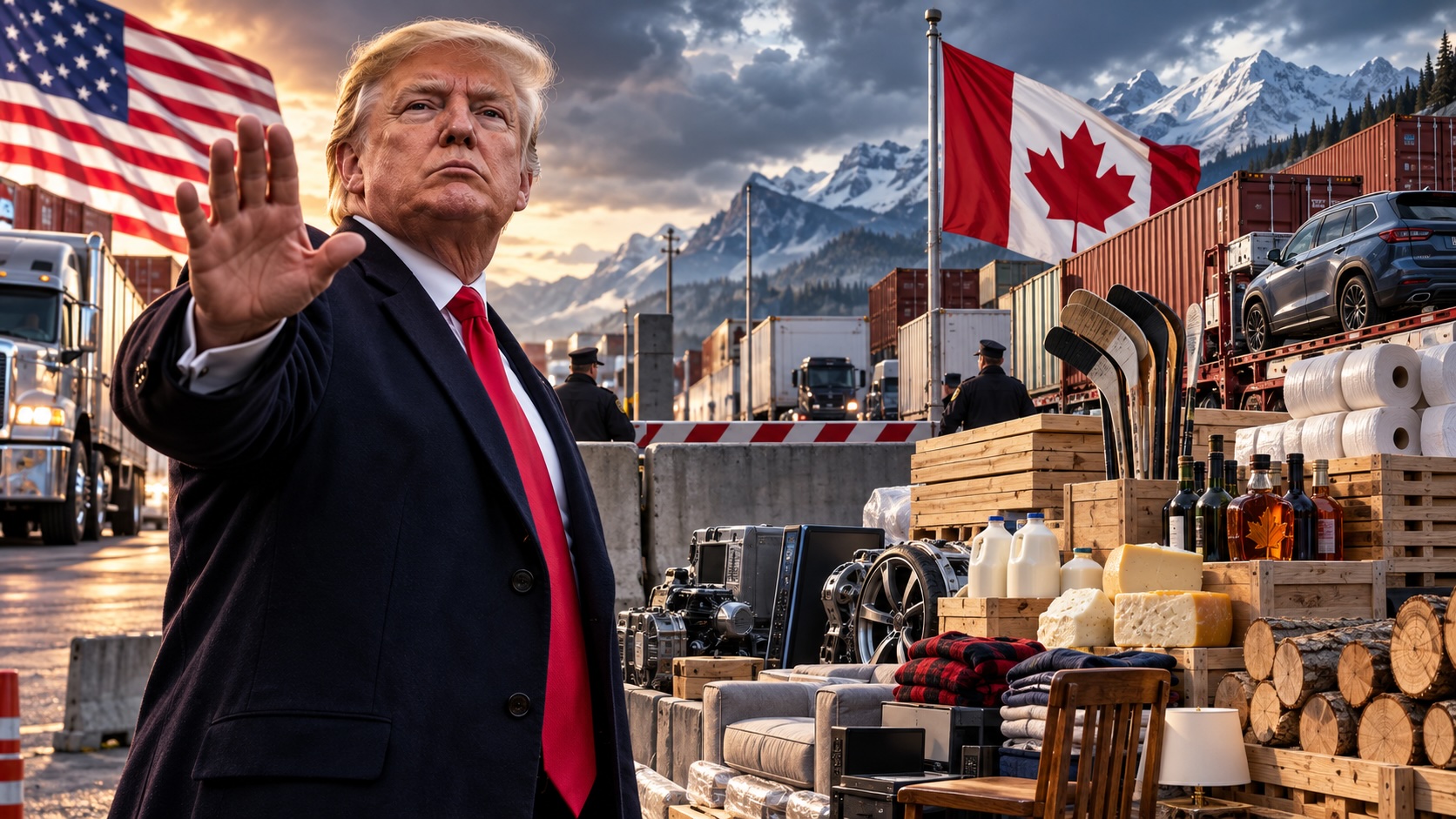
Back in July, President Donald J. Trump stood up to Canada and used Section 338 of the Tariff Act of 1930 to put a 50% tariff on a wide list of Canadian goods. The legal findings were about Ottawa’s treatment of American alcohol, dairy, and motor vehicles. The annexes went further than those three sectors. They also hit hockey sticks, paper, wood products, clothing, electronics, furniture, and more. USTR put the package at about $20 billion, or roughly 5% of U.S. goods imports from Canada. The duties took effect in late August, after a three-day pause.
The White House warned that if Canada answered with matching tariffs, the next step would not be another tax. It would be a closed market for part of the list.
Canada answered dollar for dollar. On September 8 it put levies of 15, 25, and 50% on 19.5 billion including steel, dairy, farm equipment, appliances, furniture, clothing, and electronics. Provincial liquor boards had already yanked American bottles off the shelves.
Section 338 lets the President add duties of up to 50% on goods that face unequal treatment abroad. If that treatment is maintained or increased after the duties take effect, the same statute lets him exclude products from importation. The provision has been on the books since Smoot-Hawley.
Washington threatened France, Spain, Germany, Japan, and China with it in the 1930s and in 1949. No president ever imposed the duties or the ban. Trump is the first to enforce the law and demand that American goods get a fair shake.
On September 8, after Canada’s counter-tariffs took effect, the President signed five more orders. Three turned part of the July list into an outright ban effective September 29. Two reshuffled the remaining duty lists effective September 15. Rock salt and cement came off.
ATVs and more dairy went on. Canada still limited how much American milk and cheese could come in and charged a high tax on anything above that limit. The auto rules Washington complained about had not changed. Those two fights were still open when the ban hit.
At 12:01 a.m. Eastern Time on September 29, 2026, importation of Canadian goods under 68 Harmonized Tariff classifications was shut off. Fifty-three of those lines are alcoholic beverages. Fourteen are dairy-related. One covers large motorcycles, as reported by the New York Post.
The ban is narrow. Packaged beer, wine, spirits, cider, and nonalcoholic beer are out. Bulk alcohol for U.S. bottling can still enter at 50%. Whey and molasses are barred. Most cheese is not. Motorcycles and mopeds over 800 cc are blocked, including Can-Am’s Spyder and Canyon. Customs will unconditionally reject those lines.
The banned trade is under $1 billion. Most of it is drinks.
This is not a blockade. Capital Economics puts the ban at roughly 0.25% of Canada’s exports to the United States. Two-way U.S.–Canada goods and services trade was an estimated $872.3 billion in 2025. Crude, gas, and power still move. Goods imported before the cutoff, but not yet entered for consumption, can still come in at the 50% rate set in July. Everything on the September 29 annexes does not come in at all.
The Trump administration’s test is clear and non-negotiable. If American commodities do not get the same treatment Canada gives others, Washington will not keep the U.S. market open for those Canadian goods. July was the tax. Midnight was the method. Sixty-eight Harmonized Tariff numbers are no longer a bargaining chip. They are out until the terms change.

