

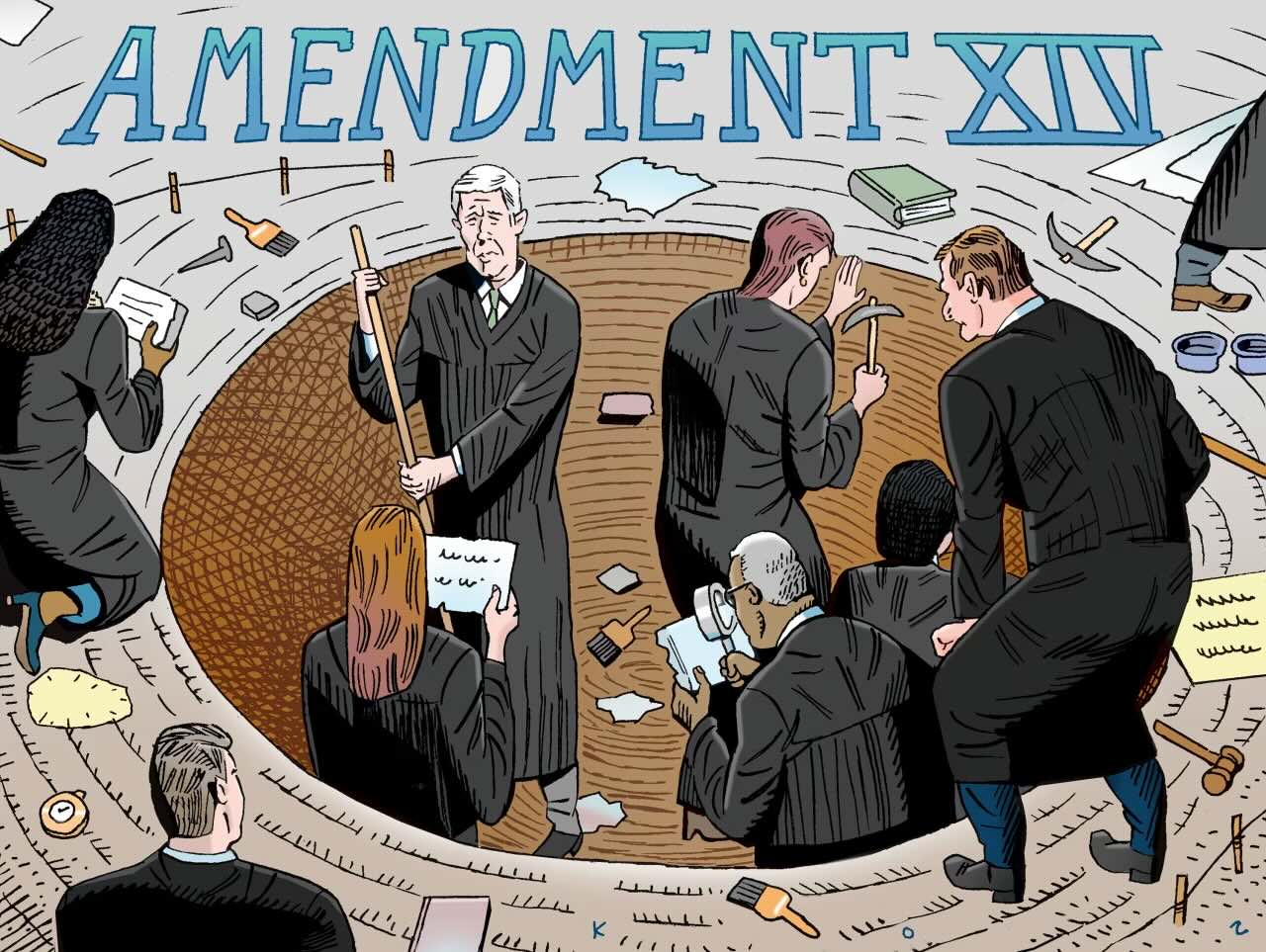
The 14th Amendment’s authors would exclude illegal and visiting aliens from U.S. ‘jurisdiction.’
President Trump’s executive order denying birthright citizenship to U.S.-born children of nonresident aliens goes before the Supreme Court Wednesday, and conventional wisdom has it that the president will lose in Trump v. Barbara. If the court stays true to the original meaning of the 14th Amendment’s Citizenship Clause, however, the conventional wisdom will prove wrong.
The clause grants citizenship to persons who meet two conditions: birth in the U.S. and being “subject to the jurisdiction” of the U.S. The dispute is over the meaning of the latter term. Everyone agrees that it excludes at least three classes: children of diplomats, of soldiers from an invading army, and of American Indians maintaining tribal relations. In each of these categories, the status of the child depended on the status of the parent.
The constitutional debate is about the original concept embodied in the text that explains these exclusions and whether that concept embraces or excludes children born on U.S. soil to parents who are unlawfully or temporarily in the U.S. The court has never squarely addressed this question.
Before Mr. Trump’s executive order, what originalist scholarship existed on the original meaning of “subject to the jurisdiction” was sporadic and lightly tested if at all. The past year has produced an explosion of originalist scholarship on both sides. The justices are now in a good position to decide which side has presented the stronger originalist case.
Kurt Lash of the University of Richmond has examined the congressional debates over the 14th Amendment and the Civil Rights Act of 1866. That act declared that “all persons born in the United States and not subject to any foreign power” are citizens. The 14th Amendment was intended to constitutionalize, not alter, the Civil Rights Act. Congress re-enacted the same language after the 14th Amendment was adopted, suggesting an identical operation. But the drafters of the 14th Amendment saw a need for constitutional language that more clearly excluded the children of tribal Indians.
Sen. Lyman Trumbull (R., Ill.), who managed the Citizenship Clause in the upper chamber, explained that “subject to the jurisdiction” meant “not owing allegiance to anybody else,” whether to a tribe or a foreign power. Rep. John Bingham (R., Ohio), the moving force behind the 14th Amendment, used the same framework, referring after ratification to persons born in the U.S. “and not owing allegiance to any foreign power.” These statements, and others Mr. Lash identified, demonstrate how leading Republicans explained the concept the text was meant to capture: birth plus full political membership.
Opponents of this interpretation rely heavily on a statement by Sen. Jacob Howard (R., Mich.) that the clause would “include every other class of persons” besides children of diplomats. In isolation, Howard’s statement does support the challengers’ understanding. But it can’t be taken literally; otherwise it would include tribal Indians. Howard later said that the relevant “jurisdiction” was the “full and complete jurisdiction” that tribal Indians lacked. Republicans didn’t maintain that tribes lay wholly beyond federal power, but that tribal members maintained an undissolved allegiance to a separate sovereign political community.
The Supreme Court endorsed this concept of jurisdiction in Elk v. Wilkins (1884), which excluded tribal Indians from birthright citizenship. Justice Horace Gray didn’t say that “jurisdiction” means being subject to ordinary criminal or civil law, as opponents of the president’s order maintain. He said it meant being “completely subject” to the political jurisdiction of the U.S. and owing it “direct and immediate allegiance.” (Congress effectively repealed the exclusion with the Indian Citizenship Act of 1924.)
Opponents of the executive order claim that “jurisdiction” simply refers to the applicability of ordinary civil and criminal laws. They invoke U.S. v. Wong Kim Ark (1898), in which the high court granted birthright citizenship to a man born to Chinese parents. They read Wong Kim Ark and other sources as having incorporated British common-law doctrine deeming anyone born in the British Empire a subject of the crown. But Ilan Wurman of the University of Minnesota has shown that the common-law materials are more complicated. The older cases and treatises turned not simply on place of birth, but on protection, allegiance and the sovereign’s acceptance of the parents’ presence. Mr. Wurman also shows that the status of temporary sojourners was contested by the 19th century.
Most important, Wong Kim Ark’s parents weren’t in the U.S. illegally or temporarily. As Justice Gray put it for the court: “The question presented by the record is whether a child born in the United States, of parents of Chinese descent, who, at the time of his birth, are subjects of the Emperor of China, but have a permanent domicil and residence in the United States, . . . becomes at the time of his birth a citizen of the United States by virtue of the first clause of the Fourteenth Amendment of the Constitution.”
The government isn’t asking the court to disturb Wong Kim Ark’s treatment of children born to lawful permanent residents—who nowadays have green cards. Mr. Trump’s executive order maintains birthright citizenship for the children of green-card holders while excluding those whose parents are in the U.S. illegally or on nonresident visas.
In its briefs, the government has added a corroborative textual point. The Citizenship Clause says that those born here and subject to U.S. jurisdiction are citizens of the U.S. and “of the State wherein they reside.” Resting state citizenship on residency reinforces the thesis that citizenship generally requires residence, not mere presence.
Opponents of the executive order have produced no evidence that any of the 14th Amendment’s framers clearly stated their position, except for Sen. Benjamin Wade (R., Ohio), who proposed a version of the Citizenship Clause that would have extended citizenship to all persons born in the U.S. without the added jurisdiction requirement—a formulation Congress didn’t adopt. If the conventional wisdom was indeed the original meaning, its defenders should be able to identify members of the enacting coalition who said so.
Some opponents, perhaps sensing the strength of the administration’s constitutional position, have suggested that the court avoid the question by striking down Mr. Trump’s order as contrary to the Immigration and Nationality Act of 1952. That law incorporates the language of the 14th Amendment, but this view contends that lawmakers in 1952 understood “jurisdiction” in the now conventional sense of ordinary law.
Even if some legislators misunderstood the original meaning of the language they were using, however, it is implausible to conclude that Congress enacted a fundamental change in the law—especially given that the 1952 law explicitly clarified citizenship rules for children born in U.S. territories and to U.S. citizens abroad.
In a 1991 interview, retired Chief Justice Warren Burger scorned the view that the Second Amendment’s right to keep and bear arms belongs to individuals rather than a collective militia. He called it “one of the greatest pieces of fraud—I repeat the word ‘fraud’—on the American public by special-interest groups that I have ever seen in my lifetime.” Such was the power of conventional wisdom before sustained originalist scholarship was done.
After originalist scholars reopened the Second Amendment, the court endorsed the individual-rights view in Heller v. District of Columbia (2008). Many of the same historians and law professors who today defend the conventional wisdom on the Citizenship Clause insisted—and insist to this day—that Justice Antonin Scalia got it wrong in Heller.
The situations aren’t identical, but the pattern is familiar. Conventional wisdom was wrong about the original meaning of the Second Amendment. It is wrong again.
Mr. Barnett is faculty director of the Georgetown Center for the Constitution and a co-author of “The Original Meaning of the Fourteenth Amendment: Its Letter and Spirit.”
By the Wall Street Journal – https://www.wsj.com/opinion/trump-is-right-on-birthright-citizenship-954ae377?st=tWd4Ha

