

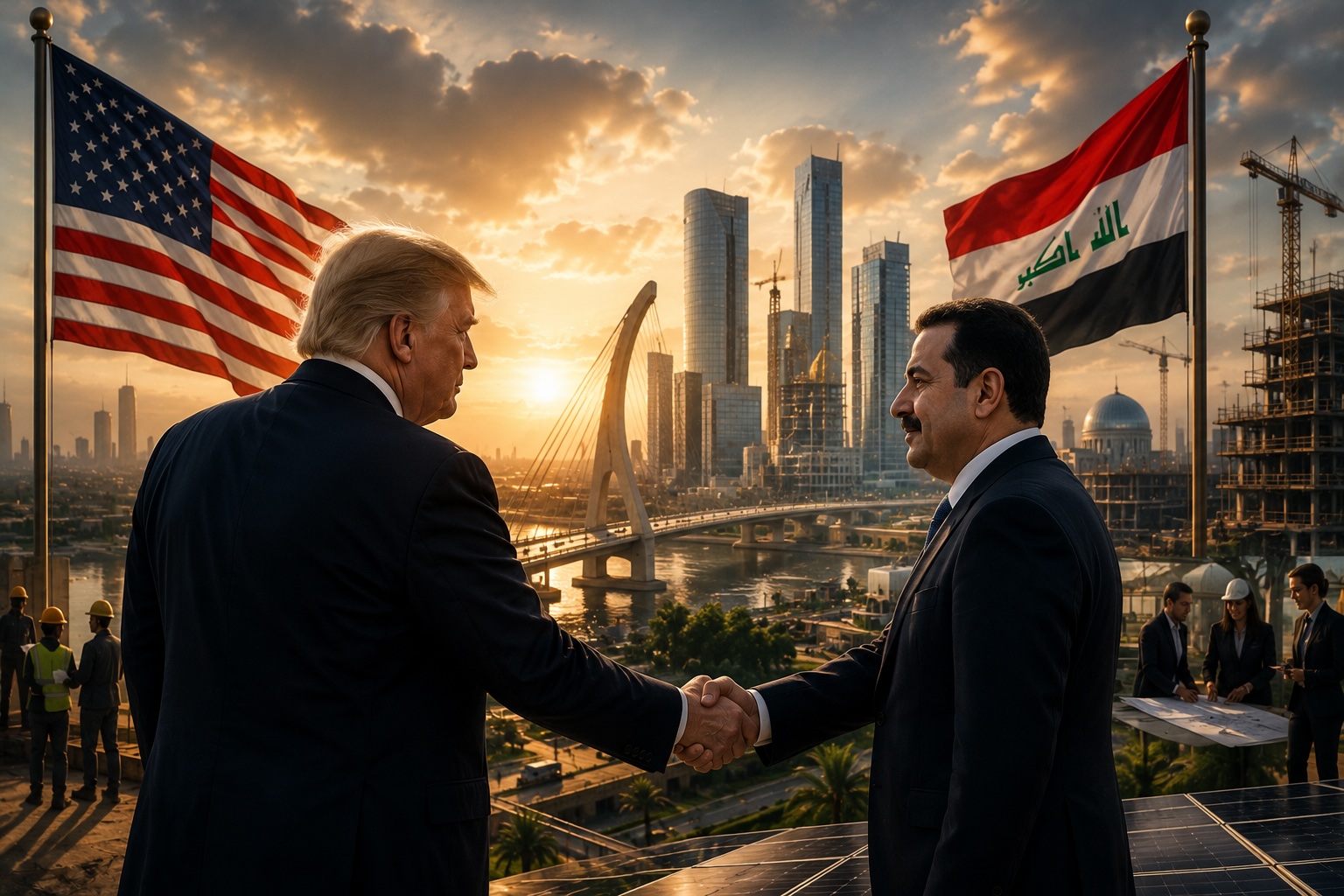
For more than two decades Iraq has been synonymous in the minds of many Americans with war, sacrifice, terrorism, and seemingly endless military commitments. Presidents came and went. Strategies changed. Trillions of taxpayer dollars were spent, thousands of brave American service members made the ultimate sacrifice, and countless more returned home carrying the physical and emotional scars of war. Yesterday, however, President Donald J. Trump signaled that America is finally turning the page. His Oval Office meeting with Iraqi Prime Minister Ali al Zaidi represented far more than another diplomatic gathering. It marked the beginning of an entirely new relationship founded upon commerce, investment, energy development, and mutual prosperity instead of endless conflict.
Prime Minister Ali al Zaidi is among the youngest leaders in the Middle East. At just 41 years of age, he rose from the private sector into Iraqi politics and was selected to lead Iraq in May 2026 after a period of intense political negotiations following national elections. Born and raised in Iraq, al Zaidi built his reputation as a businessman before entering public service, presenting himself as a reform minded leader determined to modernize Iraq’s economy and reduce corruption. His election represented a generational shift in a nation that has endured dictatorship, foreign occupation, sectarian violence, Islamic terrorism, and persistent political instability. Whether he ultimately succeeds remains to be seen, but he clearly understands that Iraq cannot build a prosperous future while remaining trapped by the ghosts of its past.
President Trump welcomed the Iraqi leader with unmistakable warmth, praising him repeatedly before reporters gathered in the Oval Office. Trump described al Zaidi as “an amazing man,” “a great leader,” “a great fighter,” and “a great fan of America.” He remarked that the two men had developed “tremendous chemistry” almost immediately and joked that the prime minister was “young and handsome, which I don’t like.” The room erupted in laughter, but beneath Trump’s characteristic humor was an unmistakable message of confidence. He expressed his belief that Iraq finally has a leader capable of steering the nation toward stability, prosperity, and a genuine partnership with the United States.
President Trump also emphasized Iraq’s extraordinary natural wealth, pointing to its enormous oil reserves and vast economic potential. He stated that major commercial agreements involving American companies are already taking shape and indicated that additional announcements will soon follow. Trump explained that America’s future relationship with Iraq should no longer revolve around military deployments but instead around business partnerships that create jobs, generate investment, and produce lasting economic growth. In one of his most significant observations, the President reiterated that the United States no longer needs to define its presence in Iraq through combat operations. Instead, he envisions American engineers, investors, energy producers, financial institutions, and entrepreneurs becoming the primary ambassadors of American influence.
Prime Minister al Zaidi responded with equal enthusiasm, describing the visit as the beginning of a true economic partnership between the two nations. Speaking through an interpreter, he thanked President Trump for the warm reception and declared that Iraq wants its future relationship with America to be centered upon investment, technology, finance, infrastructure, and energy development. He proudly referred to Iraq as “the oldest civilization in the world” extending its hand to what he described as the world’s greatest economic and technological power. He pledged to strengthen Iraqi sovereignty, continue financial reforms, attract American businesses, and build an economy capable of providing opportunities for future generations of Iraqis.
Perhaps the most significant announcement to emerge from the meeting was the confirmation that the remaining American military presence in Iraq is expected to conclude by the end of September. That decision reflects a remarkable transformation in American strategy. Rather than serving indefinitely as Iraq’s security guarantor, the United States is transitioning toward a relationship based upon trade, commerce, diplomacy, and private enterprise. It is the difference between constantly repairing a leaking roof and finally constructing a stronger foundation that can withstand future storms. President Trump has consistently argued that America’s strength should be measured not merely by military power, but by its ability to create prosperity that benefits both our nation and our allies.
This new partnership carries enormous potential benefits for the American people. American energy companies could secure substantial new opportunities to develop Iraq’s vast oil and natural gas resources. American engineering firms may participate in rebuilding infrastructure that was damaged by decades of conflict. Manufacturers could find new markets for their products, while financial institutions and technology companies gain access to an emerging economy eager for modernization. Every successful commercial agreement has the potential to create jobs here at home, expand American exports, strengthen our energy sector, and reinforce the United States as the world’s leading engine of innovation and economic growth.
The strategic implications extend well beyond economics. Iraq occupies one of the most important geographic positions on the planet, sitting at the crossroads of the Persian Gulf, Türkiye, Syria, Jordan, and the broader Middle East. A stable and prosperous Iraq can serve as a commercial bridge connecting regions that have too often been divided by conflict. Pipelines, highways, railways, electrical grids, and digital infrastructure can become the arteries through which commerce flows instead of violence. Just as healthy blood vessels sustain the human body, reliable trade routes and economic partnerships can sustain regional stability in ways that military force alone never could.
Yet no serious observer should ignore the dangers that remain. For years, Iran has worked tirelessly to extend its influence inside Iraq through political proxies, militia groups, intelligence operations, and economic leverage. Tehran has sought to transform Iraq into a strategic buffer and a platform from which it can project power throughout the Middle East. Iranian backed militias have repeatedly challenged the authority of Iraq’s elected government while threatening both Iraqi citizens and American interests. The road ahead will not be easy because dismantling years of foreign interference requires patience, determination, and strong leadership from Baghdad.
Encouragingly, Prime Minister al Zaidi spoke directly about strengthening Iraqi sovereignty and ensuring that weapons remain under the authority of the Iraqi state. Those commitments are essential if Iraq hopes to emerge as an independent nation rather than remaining caught in the geopolitical tug of war between competing regional powers. President Trump has long maintained that genuine allies must be capable of standing on their own feet while working cooperatively with the United States. That philosophy encourages independence rather than dependency and partnership rather than permanent occupation.
President Trump also reminded Americans that he opposed the original Iraq invasion long before entering politics, arguing that the United States had pursued the wrong strategic course. Yesterday’s meeting demonstrated that he is determined to write a different final chapter. Instead of defining America’s legacy through another generation of military deployments, he seeks to define it through economic opportunity, energy production, commercial investment, and mutually beneficial partnerships. Like a skilled architect who transforms the ruins of an old structure into the foundation for something stronger, President Trump is attempting to replace the architecture of endless war with the framework of enduring prosperity.
America and Iraq still face significant challenges, and no one should pretend that decades of instability disappear overnight. Nevertheless, yesterday’s meeting offered something that has been absent from the region for far too long, namely a hopeful vision rooted in common interests instead of perpetual conflict. If Iraq continues on the path of reform, resists Iranian domination, strengthens its democratic institutions, and embraces free enterprise, it can become one of America’s most valuable partners in the Middle East. That would not merely represent a diplomatic success. It would stand as another example of President Donald Trump’s belief that lasting peace is most often secured not by endless wars, but by strong allies, thriving economies, and the shared pursuit of prosperity.

