

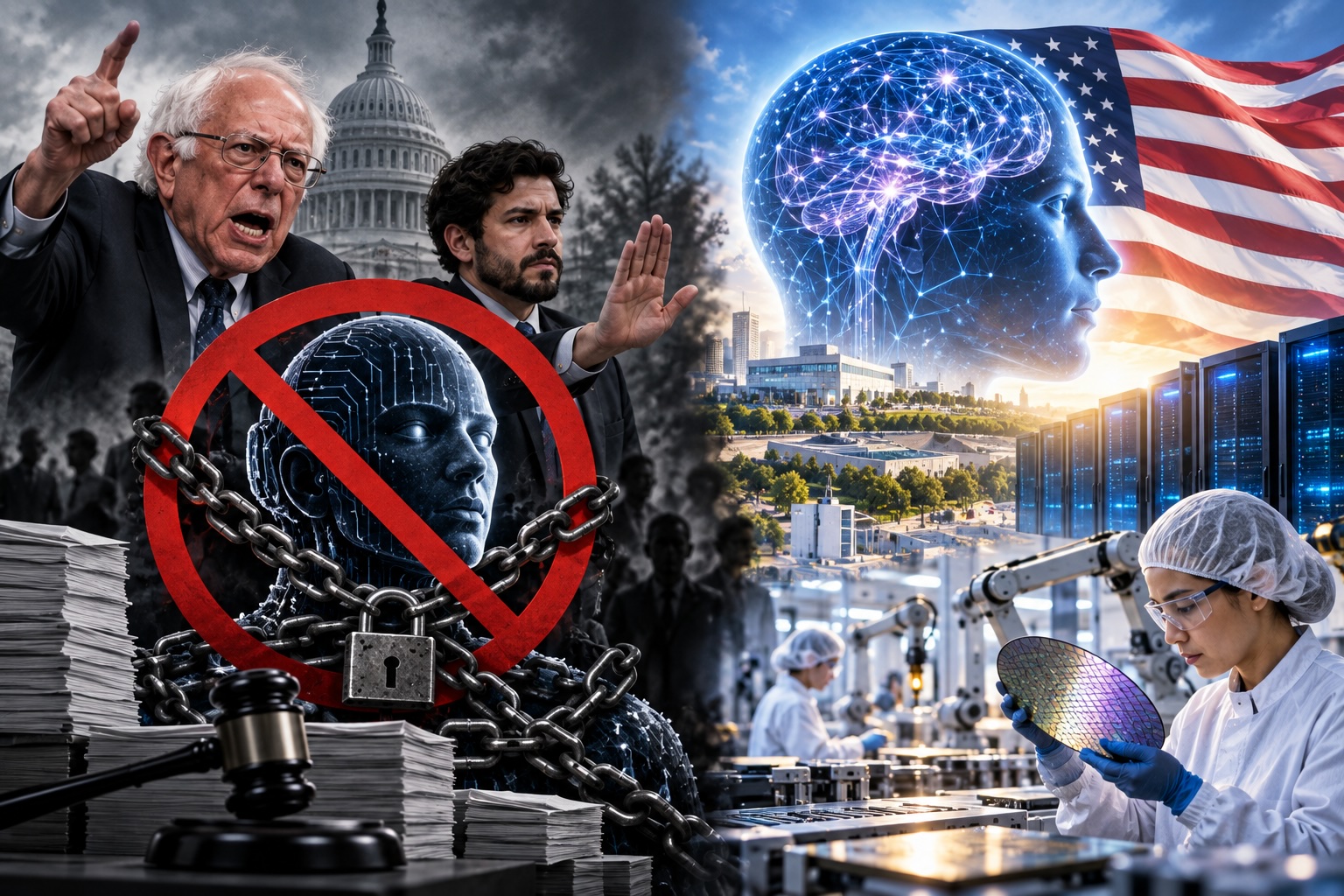
Self-described democratic socialist Sen. Bernie Sanders and progressive Rep. Greg Casar on September 3 announced the Ban Artificial Superintelligence Act, legislation to permanently ban the development and deployment of artificial “superintelligence.”
The measure would also pause advanced AI until a new Cabinet-level regulator writes the rules, and would threaten companies with a so-called “corporate death penalty” and individuals with up to 20 years in prison. The full text has not been released.
That goes well beyond the AI oversight path already taking shape inside the Trump White House, which includes voluntary pre-release federal reviews and talks about a government-supervised independent organization to conduct those reviews.
President Trump discussed that idea last month with Meta CEO Mark Zuckerberg, as reported by Politico.
The Trump administration’s stated goal is to keep the United States ahead of China, not to freeze the field while Washington invents a new bureaucracy.
Private American companies have already poured enormous sums into advanced chips, computing, and frontier models; and this administration’s stated aim is to keep that lead, not freeze it.
Sanders is reaching for a familiar play from the Socialist playbook: take a frontier technology, declare the private sector too dangerous to be trusted, and hand power to a new federal agency.
The Ban Artificial Superintelligence Act would outlaw systems said to surpass human intelligence, threaten government overthrow, or resist shutdown commands; terms that are still fiercely contested even among researchers.
The office summary also covers systems that match human-level performance across a broad range of tasks, or that can easily be modified to get there; not only systems that already “surpass” humans.
Politico notes the obvious practical problems: defining “superintelligence,” getting ambitious legislation through a Congress that is barely in session, and the near-certain opposition of the labs whose models now drive their valuations.
Daniel Castro, president of the Information Technology and Innovation Foundation, slammed the proposal as “a profound mistake” that would benefit Beijing. “Advanced AI presents real questions that policymakers should continue to take seriously, but its benefits are already tangible, while many of the most dire risks remain speculative,” he said in a statement. “America should lead in advanced AI, not ban it.”
This is not Sanders’ first attempt to hit the brakes. He was the first member of Congress to call for a national moratorium on data-center construction, an idea later written into legislation with Rep. Alexandria Ocasio-Cortez.
The idea has since stirred bipartisan friction.
A few Republicans have called for a pause of their own. Texas stopped new data-center approvals until regulators can audit water and power demand; a question of the grid and finite resources, not a ban on intelligence itself.
Those are different fights. One is about siting, electricity, and water. The other is about telling American labs they may not keep building. Even the water argument is not as simple as “AI drinks the tap.”
That is a local water-and-siting problem, not a reason to outlaw the next model.
Newer facilities increasingly spare tap water. They use closed-loop cooling that recirculates the same water instead of evaporating it, air cooling, or reclaimed wastewater that never enters the drinking supply. Microsoft, Amazon, Oracle, and others have already built or announced systems that cut or eliminate ongoing potable-water draw for cooling.
Local audits of power and water still make sense. A nationwide freeze on the machines that run American AI does not.
Sanders wanted the government to take ownership of the labs. Trump’s position is the opposite of socialism: let American companies keep building, keep the lead over China, and let the gains show up in growth — not in a new federal claim on the firms.
A pause that applies only to the United States while China keeps training is not a global strategy. It is the U.S. giving up the field by itself.
Artificial intelligence is already giving all people of all walks of life learning tools, productivity, and options that did not exist a generation ago. Innovation has raised living standards for 250 years in this country because inventors were allowed to build.
A ban that tries to time-stamp American capability does the opposite. Socialism’s habit is to pull power from builders and park it in government. This bill is that habit applied to the most important technology of the decade.
Why stop it here? Why hand China the opening?
The United States has set the technical standard for a reason. Sanders’ proposal would not civilize AI. It would slow the country that still has the best chance to set the standard.
Twenty years in prison for building advanced software is a preposterous penalty, and it is one reason this bill should not be treated as a serious governing document.
GovTrack lists Sanders as the primary sponsor of eight measures that became law across his House and Senate career. Several of those were post-office namings and other narrow, non-lifechanging items. He has introduced more than 500 bills. Almost none of his headline proposals became law as written.
This is another case of taxpayer money, staff time, and political theatre on a measure that will not pass. That record sits on 35 years of federal lawmaking, 16 in the House and nearly 20 in the Senate, and more than four decades in elected office if his eight years as mayor of Burlington are counted.

