

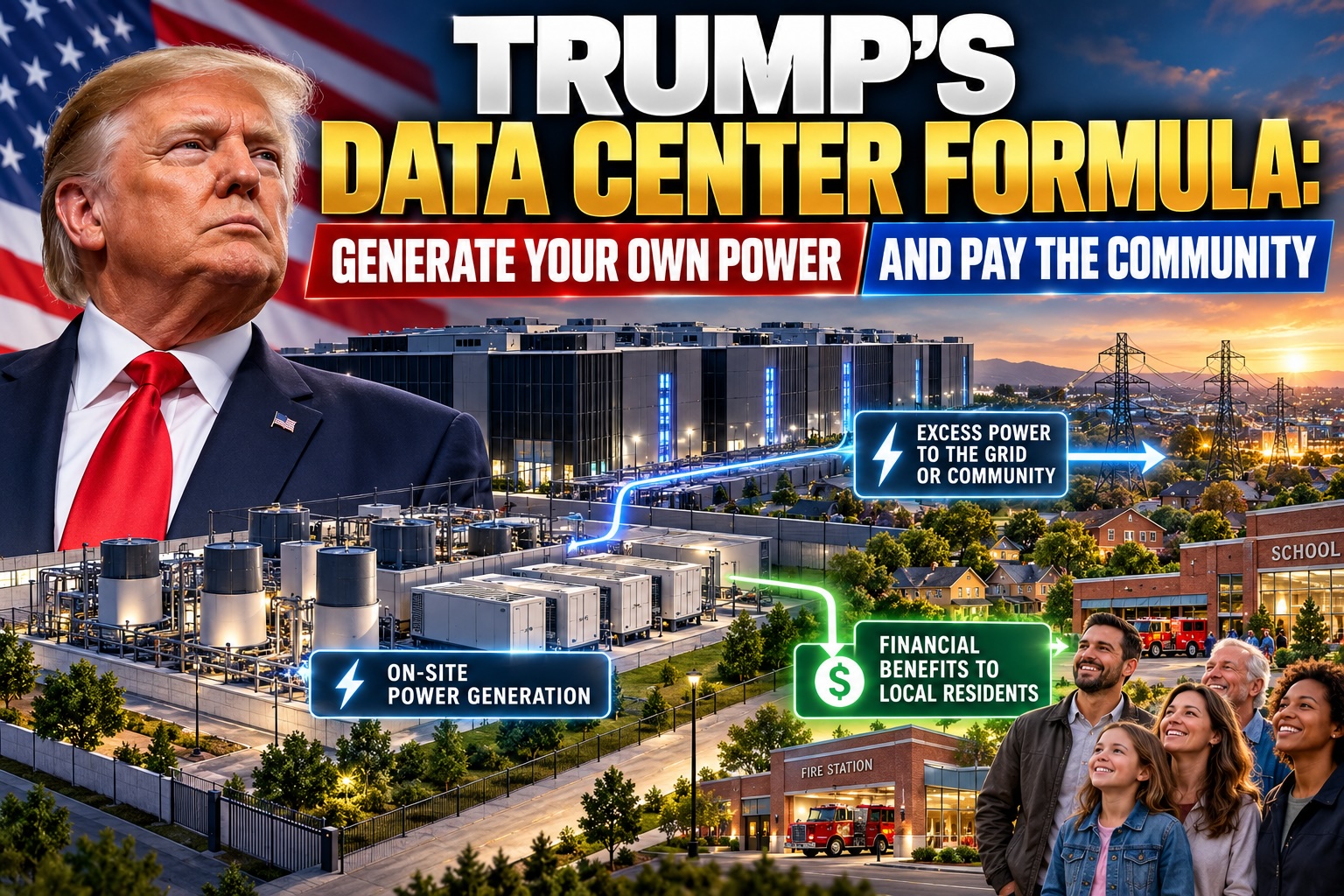
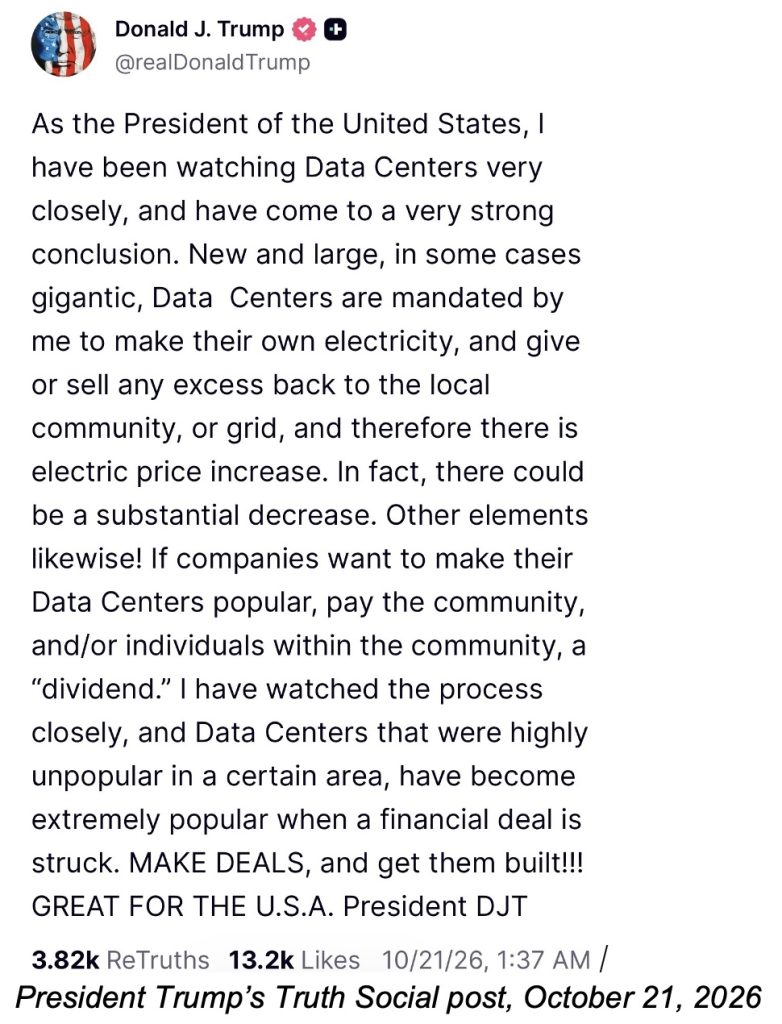
President Trump made it clear to the American people in an early-morning Truth Social post on October 21 that new and large data centers are “mandated by me to make their own electricity,” and he called on companies to share financial benefits with host communities if they want the projects to gain local support. He argued that self-generated power, with any excess sold or given back to the grid or community, could hold down electricity prices or even reduce them, while direct deals with residents would help clear opposition and “get them built.”
Trump’s larger aim is to accelerate construction inside the United States so the country stays ahead in artificial intelligence. The United States has long been the world’s technology leader, home to the greatest tech companies and the birthplace of the modern industry in Silicon Valley. Maintaining that edge requires building the infrastructure here on our soil, rather than overseas.
Data centers have drawn opposition in some towns over noise, land use, environmental effects, and utility costs. Yet workable answers already exist. Many modern facilities use closed-loop cooling, filling the system once and continuously recirculating the same water or coolant inside the building, much like a car’s radiator, so they do not keep drawing from the local water supply. QTS, Meta and Microsoft have adopted these sealed systems, allowing the facilities to largely handle their own cooling while returning value to the surrounding area. Clear education and outreach on these arrangements is also expanding.
The shared concern over local impacts has drawn unusually broad attention. Much of the intensity of the pushback traces to documented foreign influence operations. In late August, X identified and purged a roughly 200,000-account Chinese bot farm, including about 200 accounts that flooded the debate with coordinated posts designed to manipulate American opinion on AI and energy policy. These foreign accounts amplified claims that data centers drive up household electricity prices and strain the grid. That Chinese propaganda operation is widely viewed as a primary driver of the online opposition.
Where localities have already struck deals or simply taxed the industry, the benefits have been concrete. Loudoun County, Virginia, now draws roughly 45% of its local tax revenue from data centers while using only about 3 % of its land; the average homeowner would pay roughly $5,800 more a year without that base, and the county has cut its property tax rate every year for a decade. Quincy, Washington, gets about 65% of its property tax revenue from data centers and has lowered residential rates by roughly 70%, funding a new high school, fire station, city hall, and medical center.
A Meta facility in DeKalb, Illinois, helped the city cut its local tax rate from 11.5% to 7.9% while adding about $19 million a year to school funding. Elk Grove Village, Illinois is sending gift cards to every household after data-center sales generated millions in transfer taxes. Meta’s project in Richland Parish, Louisiana, has produced teacher bonuses above $50,000 and more than $1 billion in local infrastructure work.
The Trump administration has prioritized rapid data-center construction and secured voluntary pledges from major tech firms that their projects would not raise electricity costs for existing ratepayers. Requiring the facilities to generate their own power helps deliver on that pledge, and a resident dividend offers a further step to ease remaining local resistance. Officials, industry leaders, and voters largely accept that the infrastructure must be built somewhere and that places that host deserve a direct share of the upside.
Trump has long treated data centers as essential to American economic strength and competitiveness with China, a view shared by other industry figures including Elon Musk, who has repeatedly argued that the United States must rapidly expand domestic AI infrastructure and power capacity or risk falling behind. His more recent emphasis on self-generation and resident dividends shows a results-oriented approach designed to win local support, clear obstacles, and accelerate the buildout. Industry leaders have responded favorably. One executive at a data-center firm told CNBC that directing more rewards to the places that host them is a sensible idea and that similar benefits already flow through tax revenue, education investments, and job creation. The suggestion leaves room for companies to structure the most effective deals locally without a heavy-handed federal mandate.

