

By Roger Stone
What Former President Donald J. Trump is being accused of in the federal indictment lead by political hitman Jack Smith is summed up as follows;
- Having Classified Documents that he was not authorized to have;
- Refusing to return the documents to to the appropriate officer and employee of the United States entitled to receive them (Nara);
- Showing the Classified Documents to persons who were not authorized to see them;
- Obstructing Justice in preventing the documents from being returned and giving false information to the FBI & DOJ about the documents.
It then logically follows that:
IF Trump was authorized to have the documents in question as a result of the Presidential Records Act and/or because they had been declassified by Trump when he was President
AND
If the Statute did not require him to return the documents to NARA or any other government official,
THEN The entire indictment must be dismissed in its entirety as a matter of law.
Counts 1-31 of the Indictment against Donald J. Trump are all predicated upon the fact of Trump “having unauthorized possession of, access to, and control over documents relating to the national defense, did willfully retain the documents and fail to deliver them to the officer and employee of the United States entitled to receive them”
In addressing the issue of whether or not Trump was authorized to have the documents in question let’s start with the following regarding declassification:
After the FBI searched the Mar-a-Lago home of former President Donald J. Trump and retrieved boxes of documents, some of them labeled “top secret,” former President Donald Trump released a statement claiming that as president, he had a “standing order … that documents removed from the Oval Office and taken to the residence were deemed to be declassified the moment he removed them”
A declassification standing order is the term that was used by former President Donald Trump to describe an order he claimed to have issued while in office. According to Trump, this order authorized the instant declassification of the documents removed from the Oval Office. This order is not required to be in writing. If this is in fact the case, the indictment if done.
In an appearance on Fox News on Aug. 12, writer John Solomon, who was one of Trump’s representatives for interacting with the National Archives and Records Administration, read a statement from Trump’s office in which the former president argued that he had a “standing order” to declassify all documents taken to Mar-a-Lago, and that he didn’t need anyone or anything else to do that.
- “As we can all relate to, everyone ends up having to bring home their work from time to time,” Solomon read. “American presidents are no different. President Trump, in order to prepare the work for the next day, often took documents, including classified documents, to the residence. He had a standing order … that documents removed from the Oval Office and taken to the residence were deemed to be declassified the moment he removed them.”
- “The power to classify and declassify documents rests solely with the president of the United States,” the statement continued. “The idea that some paper-pushing bureaucrat with classification authority delegated by the president, needs to approve the declassification is absurd.”
Listen to this Statement here:
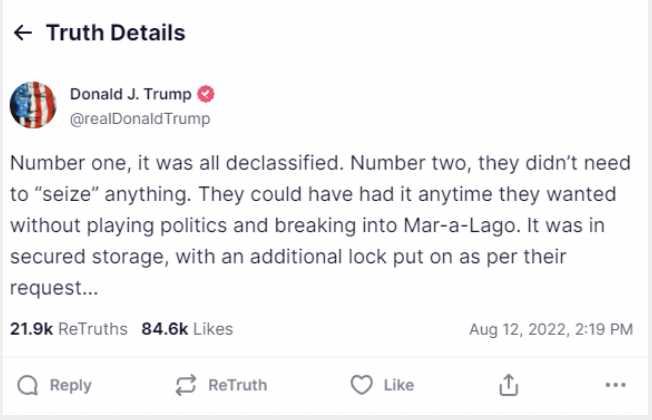
Trump, who has referred to the search as a “break-in” and a “witch hunt,” defended himself on his social media platform, Truth Social. He said the documents were “all declassified”
Corroboration:
For reference, two former and yet to be named senior aides who worked for Trump in the latter half of his term said they were aware that Trump routinely took documents to the residence rather than return them to the Staff Secretary or the intelligence official who provided them.
When these two were asked whether there was a standing order, one of the former officials stated, “I don’t know anyone or anything that disputes that.”
Pretty convincing statement which I think that Trump’s defense counsel would jump on as it is undisputed that the legal authority for declassifying national security information rests in the president’s power afforded as commander-in-chief and is merely guided by, not bound by, a series of previous presidential executive orders.
Misplaced claims of limitations about Trump’s ability to declassify by Standing Order:
Previous executive orders started with one issued by President Franklin Roosevelt in 1940 with the most recent Executive Order 13526, issued in late 2009 by then-President Barack Obama. These Executive Orders, laid out the procedures for classifying and declassifying information, and the various officials who are to be included in such decisions.
For the record, an executive order is a specific type of presidential action, an official, legally binding mandate issued by the president to federal agencies under the executive branch. An executive order merely gives federal agencies under the executive department of the government instructions on how to interpret and carry out federal law. Executive orders cannot legally bind future presidents’ actions.
Additionally and most importantly, regardless of any prior executive orders, the sitting president retains the ultimate authority to declassify documents at will subject to no formal procedures and no restrictions.
Certain members of the government have said that they cannot locate the standing order as mentioned by Trump.
Some may say that there would have to be an Executive Order or Memorandum to Declassify Documents. This is not true.
Kash Patel, a friend and chief of staff to the acting defense secretary during the Trump administration, acknowledged in a May interview in Breitbart that documents already recovered by the National Archives from Trump’s Mar-a-Lago residence in January had been declassified even though their markings had not changed.
Patel stated, “The White House counsel failed to generate the paperwork to change the classification markings, but that doesn’t mean the information wasn’t declassified. I was there with President Trump when he said, ‘We are declassifying this information.’”
In an interview on Fox News’ “Sunday Morning Futures” on Aug. 14, Patel said Trump has the power to declassify documents simply by saying so. “And this is a key fact that most Americans are missing. President Trump, as the sitting president, is the unilateral authority for declassification,” Patel said. “He can literally stand over a set of documents and say, ‘these are now declassified,’ and that is done with definitive action immediately.”
As reported by Breitbart, Charles Stimson, a senior fellow with the conservative Heritage Foundation and a former federal prosecutor, told NBC News that when Trump was president, he had “the ultimate declassification authority.” “If any president decides to declassify a document and doesn’t tell anybody — but he has made the decision to declassify something — then the document is declassified,” Stimson said.
Ric Grenell, who was Trump’s acting director of national intelligence, echoed that opinion. “There is no approval process for the president of the United States to declassify intelligence,” Grenell told NBC News. “There is this phony idea that he must provide notification for declassification but that’s just silly. Who is he supposed to notify? I think it’s the height of swampism to think the president should seek bureaucrats’ approval.”
With reference to the government recognizing the existence of the “standing order,” according to Bloomberg last month, “A “standing order” that former President Donald Trump has claimed authorized him to instantly declassify documents removed from the Oval Office could not be found by either the Justice Department or Office of Director of National Intelligence.”
Blomberg also reported that in May of 2023, in a court filing, government attorneys from the DOJ asserted to Bloomberg News that they could neither confirm nor deny whether the agencies had such a document, citing the ongoing criminal investigations against Trump.
Sound like the Biden DOJ just doing what they do best as they did with the Trump Russia collusion, hide exculpatory evidence and proceed full bore against Trump at all costs.
While in an objective DOJ or FBI, the government would seek, and perhaps find any officials or witnesses who knew or can confirm that they knew of the existence of the “standing order” as described by the Trump statement.
As the FBI has a record of hiding exculpatory evidence from Trump we should assume that their tactics and motivations have not changed and regardless of the reality of the situations and whether or not the standing order was ever issued, they will make sure that the document never surfaces and no witnesses will be able to testify about it’s existence.
Regardless of the above, it is agreed by most that the president’s declassification powers were sweeping and likely would be viewed as such by the federal court.
Getting to the indictment against Trump that was unsealed by the federal court in Miami on June 9, it outlined 37 counts of seven charges including willful retention of national defense information, corruptly concealing documents, conspiracy to obstruct justice, and making false statements.
If Trump was rightfully in possession of all of the documents in question, then the entire indictment would have to be dismissed in its entirety.
Charges 1 to 31 in the indictment fall under Willful Retention of National Defense Information 18 U.S.C. § 793(e) (The Espionage Act). This statute requires that the person charged not be authorized to possess the documents in question.
If former President Trump was authorized to possess these documents as a result of them being declassified as well as the Presidential Records Act discussed below and further as per the sole legal precedent of the Clinton Sock Drawer case, then the indictment under the Espionage Act, falls flat on its face for a multitude of reasons and must be dismissed as a matter of law.
As mentioned above, the Presidential Records Act (PRA) of 1978, and the 1990s case, popularly known as the Clinton “sock drawer” case when examined further show why the indictment must fail.
During the Clinton administration, White House staff discovered a cache of documents concerning the infamous Whitewater scandal in a White House closet — quite literally a “sock drawer” scenario. The discovery led to a political and legal storm, with many accusing then-President Clinton illegally hiding these documents. Yet, no formal charges were filed. Instead, the situation was handled as an internal administrative issue as it was supposed to.
In the Clinton “sock drawer” case, the existence of the documents in a personal space was not considered a violation of the PRA. As with Clinton, it’s crucial to note that Trump’s mere possession of these documents in his Florida residence is not illegal in itself, given his former status as President. In Trump’s case, the alleged still classified documents reportedly seized from his Mar-a-Lago residence can be viewed through a similar lens, especially when one considers the provisions of the PRA.
The PRA defines and governs the handling of Presidential records. As per the Act, documents generated or received by the President and his staff in conducting their official duties are regarded as Presidential records and remain the property of the United States.
In the Court’s decision, Justice Amy Berman Jackson wrote in part:
- Plaintiff’s entire APA claim is predicated on the notion that the Archivist of the United States has a statutory duty to make his own classification decision and “to assume custody and control” of all Presidential records. There are a number of flaws with this argument. To begin with, the plain language of section 2203(f) of the PRA does not say what plaintiff claims it does—that the Archivist must assume custody and control of all materials that fall within the definition of Presidential records. Tr. at 29:23–30:2. Rather, it states: “the Archivist of the United States shall assume responsibility for the custody, control, and preservation of, and access to, the Presidential records of that President.” 44 U.S.C. § 2203(f)(1) (emphasis added).
- Section 2203(a) of the PRA directs the President, not the Archivist, to take: all such steps as may be necessary to assure that the activities, deliberations, decisions, and policies that reflect the performance of his constitutional, statutory or other official or ceremonial duties are adequately documented, and that such records are maintained as Presidential records pursuant to the requirements of this section…. 44 U.S.C. § 2203(a).
As such, it’s plausible for a President, especially one as recent as Trump, to possess even classified documents, provided they are related to his term in office. Crucially, the PRA stipulates that a former President is allowed access to his own Presidential records, including classified documents, unless access is limited due to national security reasons or by the incumbent President, usually via an executive order. No such order has been issued by Biden regarding Trump’s documents.
Furthermore, the PRA outlines how Presidential records should be handled post-administration. The National Archives and Records Administration (NARA) is solely responsible for their custody, control, and preservation whether its with the former President or in NARA’s custody.
A former President can maintain the records or can request access to these records, and NARA typically grants this, barring national security reasons. Trump’s access to his Presidential records doesn’t seem to have been restricted and if they were additionally declassified, which is not necessary for the act to control, his possession of the classified documents should not be considered unlawful.
In light of these considerations, the Presidential Records Act and the precedent set by the Clinton “sock drawer” case offer a strong defense against the indictment of Trump.
As with the Clinton case, Trump’s situation should have been treated as an internal administrative issue rather than a criminal matter, unless clear evidence of misuse surfaces, which it was not.
The charges against Trump are also hinged on the allegation that he misused or intended to misuse classified information. However, misuse typically means sharing classified information with unauthorized individuals or using it for personal gain. So far, no clear evidence substantiates such claims including the audio recording.
Arguably, the indictment appears to be an overreach, a step too far without concrete evidence of misuse. It is essential for the courts to maintain a balanced perspective, viewing Trump’s possession of these documents through the lens of the Presidential Records Act and the historical context provided by the Clinton “sock drawer” case which we believe the court will do.
For thoroughness and in addition to the Clinton Sock Drawer case above, it is advisable to review the the National Archives and Records Administration Act (NARA Act) of 1984 to see how off the charts the DOJ’s actions are in the scale of justice. NARA states that violations can lead to administrative remedies, though specific punitive measures are not clearly defined in the Act itself.
Typically, violations are handled in a collaborative and corrective manner, involving NARA and the relevant agency or individual. This often includes identifying the source of the violation, providing remedial training, implementing new policies or procedures, and taking steps to recover or recreate lost or improperly destroyed records.
Here are some of the possible administrative remedies:
- Corrective Action: When violations occur, the first response typically involves taking corrective action to mitigate any damage and prevent future incidents. This could include retrieving improperly destroyed or removed documents, providing additional training to staff, or adjusting internal protocols to better align with the Act’s requirements.
- Referral for Disciplinary Action: If a violation is due to the deliberate actions of an individual or group within an agency, NARA may refer the matter to the agency for disciplinary action. The specific disciplinary measures would then depend on the agency’s internal policies.
- Policy Review and Development: In cases where violations stem from unclear or insufficient policy guidelines, NARA works with the agency to review and develop more effective policies for records management.
- Training and Education: One of the key administrative remedies involves further training and education. NARA provides extensive resources for training federal employees in proper records management practices.
- Reporting to Congress: In extreme cases, such as repeated or severe violations, NARA may report the issue to Congress. This step could lead to increased scrutiny, possible hearings, or legislative action to address the violation.
- Referral to the Department of Justice: If violations are of a particularly severe or criminal nature, NARA may refer the case to the Department of Justice for investigation and possible prosecution.
All in all, the DOJ’s case seems to have some rather gaping holes in it which they will do everything to ignore, downplay, spin and cover up. I am of the opinion that Trump’s attorneys should and will take every opportunity to examine these defenses, amongst others, to assure that justice prevails, the charges are dismissed and the next President of the United States will be Donald J. Trump.

