

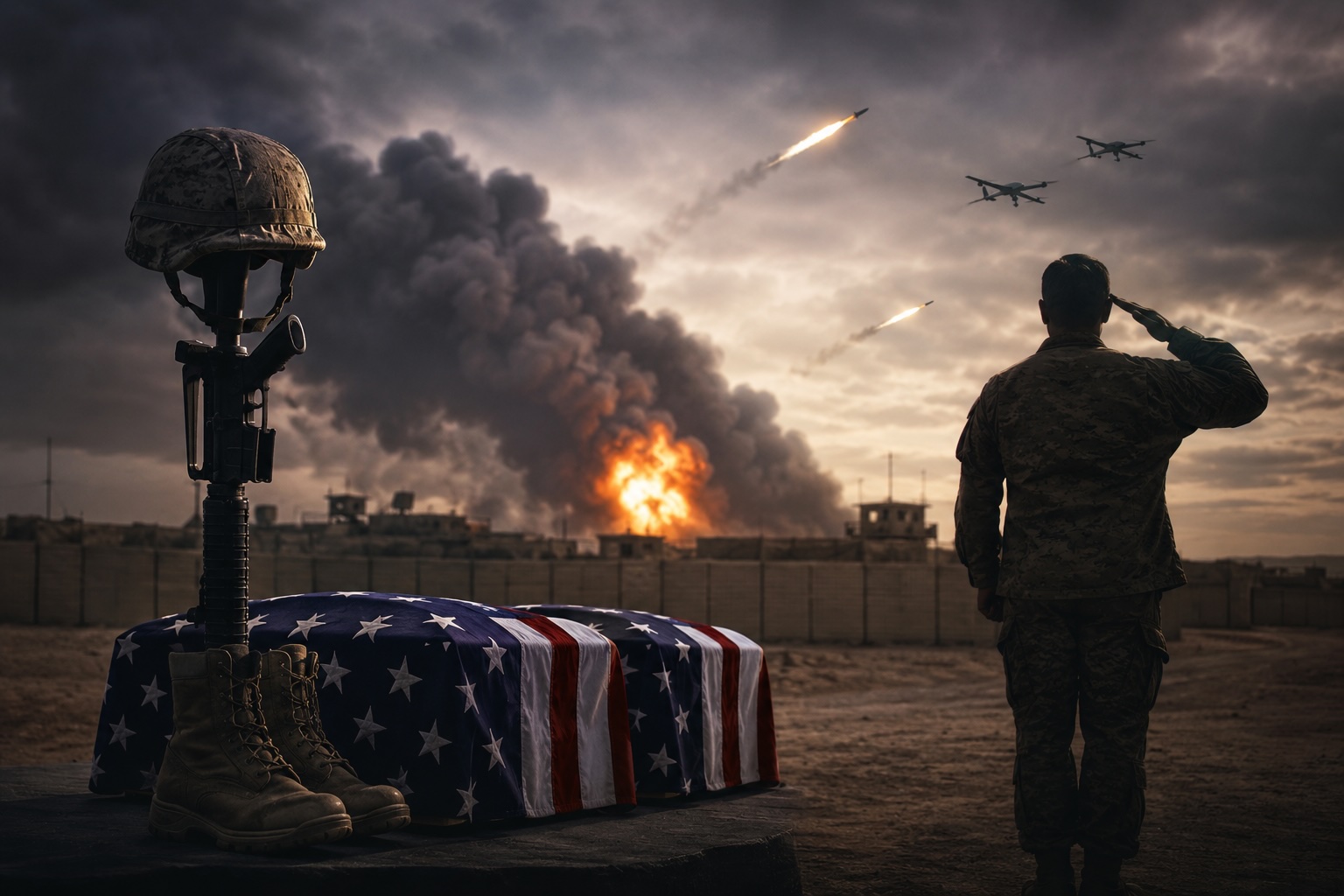
The loss of American military personnel at the hands of the Islamic Republic of Iran is a national tragedy that demands more than solemn words, lowered flags, and carefully scripted statements from Washington, D.C.. Two American service members were killed while defending a United States position in Jordan from an Iranian missile and drone attack. Another American was initially reported missing, while four wounded service members were treated and returned to duty. Elsewhere, an American service member was killed in northern Iraq while handling unexploded ordnance from a downed Iranian attack drone. Their courage, sacrifice, and devotion to duty must never be reduced to another statistic in a conflict reported by television commentators who have never heard a shot fired in anger.
The names of the fallen were initially withheld until their families could be properly notified. That is not bureaucratic secrecy. It is a final act of decency toward mothers, fathers, husbands, wives, children, and siblings whose lives have been shattered by a knock at the door. Before the American public learns the names of the dead, their families deserve the dignity of hearing the news privately and directly from representatives of the nation their loved ones served.
Our prayers are with every one of those families. We also pray for the missing, for the injured, for those who rushed toward danger to save their comrades, and for every American presently serving within range of Iranian missiles, drones, and terrorist proxies. They are not abstractions on a Pentagon map. They are our sons and daughters, our neighbors, our fellow citizens, and the guardians standing between the American people and a revolutionary regime that has spent nearly half a century exporting violence.
President Donald J. Trump now faces the grave responsibility that comes with command. He must respond decisively, proportionately, and intelligently, not because war is desirable, but because weakness invites more war. The surest way to encourage Tehran to kill additional Americans is to convince its rulers that American deaths can be absorbed without meaningful consequences. Deterrence survives only when an adversary believes that crossing a clearly drawn line will bring swift and unbearable costs.
The United States military has already conducted retaliatory strikes against Iranian military targets following the deadly attack in Jordan. Those operations were intended to punish the forces responsible and diminish Iran’s capacity to launch additional attacks. They reportedly targeted military and logistical infrastructure in southern Iran and around the strategically vital Strait of Hormuz.
The Iranian regime must understand a simple truth. American blood is not cheap. It cannot be spilled as part of some cynical calculation by clerics hiding in fortified compounds while young conscripts, foreign proxies, and ordinary civilians absorb the consequences of their ambitions. Iran’s rulers cannot launch missiles at American positions, attack commercial shipping, threaten neighboring countries, and then retreat behind diplomatic double talk when the United States responds.
For decades, Tehran perfected a cowardly method of warfare. It armed militias, financed terrorists, supplied drones, trained insurgents, and ordered attacks through intermediaries while denying direct responsibility. When Americans were killed, Iranian officials would pretend that some supposedly independent group had acted on its own. This arrangement allowed Tehran to light fires across the Middle East while insisting that its hands were clean.
That fiction has now collapsed. Iran is not merely encouraging attacks from the shadows. It has launched missiles and drones against American forces and threatened the maritime arteries through which much of the world’s energy supply travels. Iranian attacks have also endangered Jordan, Bahrain, Kuwait, Saudi Arabia, Iraq, the United Arab Emirates, and other countries that want commerce and stability rather than revolutionary chaos. Reports indicate that Iran has attacked commercial vessels and threatened vital infrastructure throughout the Gulf region.
This is not simply a quarrel between Washington and Tehran. It is a confrontation between an international order based on sovereign nations and open commerce, and a regime that uses disruption as an instrument of power. Iran’s rulers understand that they cannot defeat the United States in a conventional war. Their strategy is therefore to make the region so dangerous, expensive, and unstable that Americans lose patience and withdraw.
President Trump must not permit that strategy to succeed. He has never embraced the globalist fantasy of invading countries, occupying capitals, and attempting to manufacture Western democracies at gunpoint. He has also never subscribed to the equally dangerous fantasy that America can ignore attacks against its own forces and expect its enemies to become peaceful out of gratitude.
There is a profound difference between reckless nation building and decisive retaliation. One traps the United States in endless occupations with vague objectives. The other protects American lives by destroying the weapons, command centers, launch sites, naval assets, and military infrastructure used to attack them.
Trump’s doctrine has always been peace through strength. That doctrine does not require the permanent occupation of Iran. It does not require sacrificing thousands of American lives in an attempt to govern a country of nearly ninety million people. It requires making unmistakably clear that any attack upon Americans will result in the destruction of assets the Iranian regime values far more than it values the lives of its expendable proxies.
The Strait of Hormuz is central to this struggle. It is not some remote strip of water with no connection to the daily lives of Americans. It is one of the world’s most important energy corridors. When Iran threatens shipping there, insurance costs rise, oil markets react, transportation becomes more expensive, and American families eventually pay more for gasoline, groceries, electricity, and manufactured goods.
An attack on commercial navigation is therefore an attack on the economic security of working people around the world. Tehran knows this. Its threats against the strait are designed to use the global economy as a hostage. Iran hopes frightened governments will pressure the United States into accepting aggression rather than endure higher energy prices.
President Trump must reverse that calculation. The cost of closing or threatening the Strait of Hormuz must fall upon the Iranian military establishment, not upon American motorists. The United States possesses overwhelming naval and air power. It should use that superiority to protect navigation, neutralize missile batteries, destroy drone facilities, and ensure that no revolutionary regime can impose an economic blockade upon the free world.
At the same time, the President should leave open a clear path to deescalation. Iran can stop attacking American forces. It can stop targeting ships. It can stop threatening neighboring countries. It can abandon its nuclear ambitions and end its sponsorship of terrorist organizations. The choice belongs to Tehran.
Diplomacy without strength is merely pleading. Strength without a political objective can become destruction for its own sake. President Trump understands that successful statecraft requires both. He can impose devastating military consequences while making clear that the United States seeks neither Iranian territory nor an endless war.
The purpose of American retaliation must be precise. Protect our troops. Preserve freedom of navigation. Destroy the capability used to attack us. Prevent Iran from obtaining nuclear weapons. Restore deterrence. Then bring our forces home when the mission has been accomplished.
The American people are compassionate, but they are not weak. They do not seek war, but neither will they accept the murder of their service members as the unavoidable cost of doing business in the Middle East. Every President is ultimately judged by whether he protected the lives, honor, and security of the nation entrusted to him.
The fallen Americans in Jordan and Iraq gave everything their country asked of them. Their sacrifice imposes a solemn obligation upon those who command. Their deaths must not be exploited to justify an undefined war, but they must never be ignored in the name of political convenience.
President Trump must now send Tehran a message so clear that no interpreter, diplomat, or propagandist can distort it. The United States desires peace. The United States will accept an honorable settlement. The United States will not occupy Iran. But when Iran kills Americans, the response will be swift, overwhelming, and unforgettable.
American blood is not cheap. Under Donald Trump, those who spill it will learn the price.

