

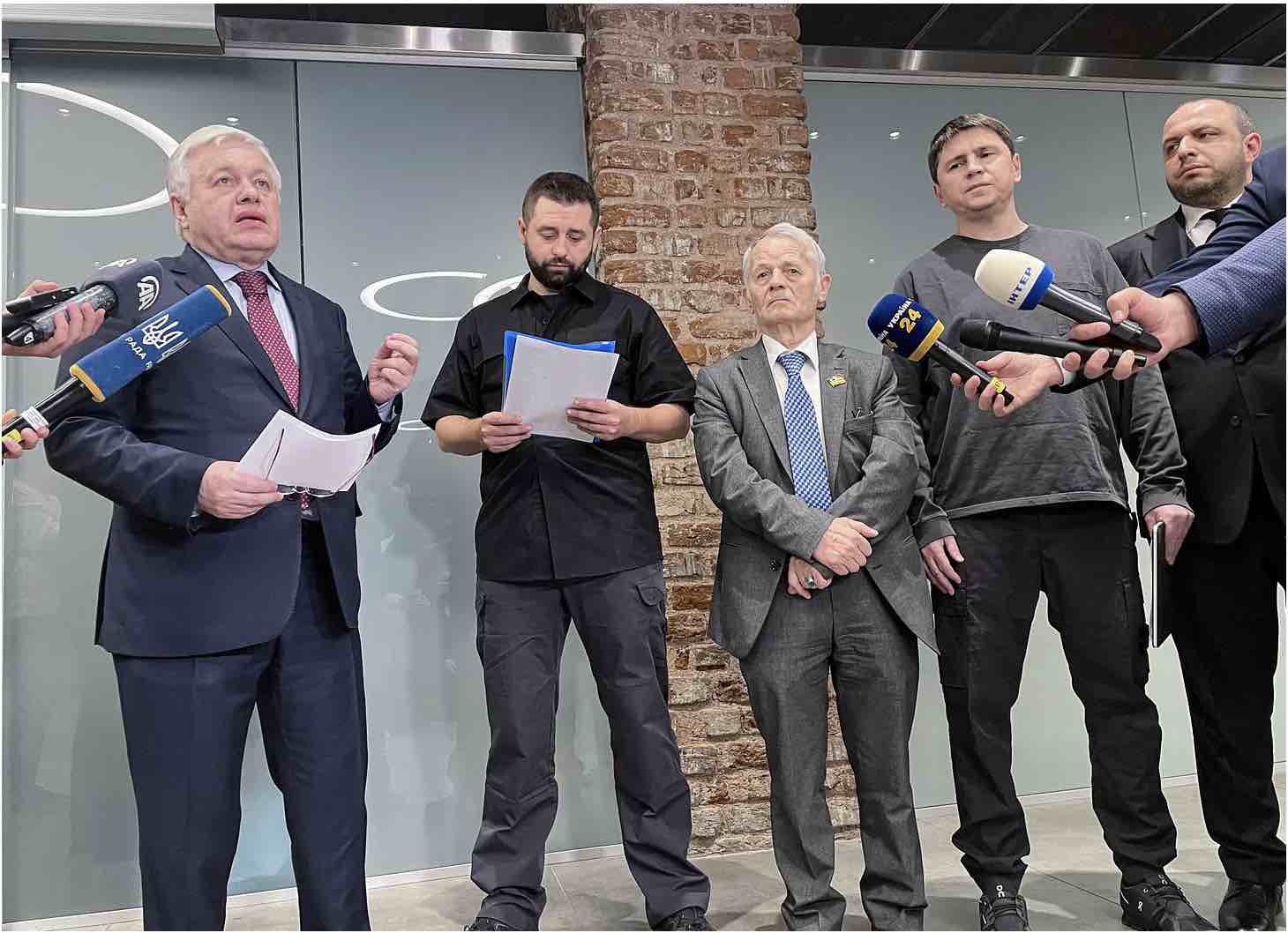
According to Davyd Arakhamia, Russia was “prepared to end the war if we agreed to… neutrality, and committed that we would not join NATO.” But the US and UK stood in the way.
By Aaron Maté
A top Ukrainian official has newly confirmed that the war could have ended – and tens of thousands of lives could have been saved – had Ukraine and its NATO allies accepted a peace deal with Moscow weeks after the February 2022 invasion.
Davyd Arakhamia is the parliamentary leader of Volodymyr Zelensky’s Servant of the People party, and head of the Ukrainian delegation at the spring 2022 peace talks held in Istanbul. In an interview last month, Arakhamia acknowledged that the Russians “were prepared to end the war if we agreed to – as Finland once did – neutrality, and committed that we would not join NATO.” For Moscow, he added, Ukrainian neutrality was “the key point” and “the biggest thing for them.”
Arakhamia offers a revealing explanation for why Ukraine ultimately refused. First, he claims, Ukraine could not have pledged neutrality without first passing a new amendment to “change the Constitution.” A constitutional measure approved in February 2019 enshrined Ukraine’s commitment to join NATO.
But at the time of the Istanbul talks, Ukraine’s government did not see its constitution as a hindrance to renouncing NATO. “I have cooled down” on NATO, Zelensky said in early March 2022. After all, he explained, “NATO is not prepared to accept Ukraine” anyway, and he did not want to lead a “country which is begging [for] something on its knees.” Therefore, just as the goal of NATO membership was only added to Ukraine’s constitution three year prior, it could just as easily have been rescinded.
A second factor, Arakhamia says, was that Ukraine had “no confidence in the Russians” to uphold an agreement, which “could only be done if there were security guarantees.” Without such guarantees, he argues, Russia could then regroup and become “even more prepared” for a second attack on Ukraine. “Therefore, we could only explore this route when there is absolute certainty that this will not happen again. There is no such certainty.”
But Arakhamia then makes clear why Ukraine could not have the “certainty” that it needed: the US and UK refused to offer Kyiv security guarantees. In his telling: “Moreover, when we returned from Istanbul, [UK Prime Minister] Boris Johnson came to Kyiv and said that we would not sign anything with them at all, and let’s just fight.” This is exactly what anonymous Zelensky aides reported in May 2022, now newly confirmed on the record by the head of the Ukrainian delegation.
In addition to Johnson’s in-person message on April 9th, Arakhamia reveals that Ukraine heard a similar response it when shared draft documents of the proposed treaty with Western allies. “They actually advised us not to go into ephemeral security guarantees [with Russia], which could not have been given at that time at all,” he recalls.
While Arakhamia now downplays the possibility of obtaining “ephemeral” security guarantees, he omits the critical fact that it was his delegation that proposed the idea in the first place. “Today we came up with an official proposal for a new system of security guarantees for Ukraine,” Arakhamia said on March 29th 2022, in an announcement posted on the Ukrainian government’s website. “…We want it to be a working international mechanism of concrete security guarantees for Ukraine.”
At the time, Zelensky spoke positively of his delegation’s proposal – and even acknowledged that security concerns had sparked Russia’s invasion. “Security guarantees and neutrality, the non-nuclear status of our state — we’re ready to do that,” Zelensky told a group of independent Russian journalists just days before his aides unveiled their proposal. “That’s the most important point … they [Russia] started the war because of it.”
The US-led opposition to providing security guarantees that would underpin a Russia-Ukraine peace deal is further corroborated by contemporaneous reporting.
Just before the talks in Turkey, NATO leaders including President Biden gathered for a summit in Brussels. At the meeting, the New York Times reported, “there was a surprising tenacity about taking on Mr. Putin.”
The tenacity for taking on Putin meant that there was little interest in taking on peace. “Western officials are balking at Ukraine’s proposal for a NATO-style mutual-defense pledge,” the Wall Street Journal reported on March 30th, one day after Ukraine unveiled it. While vowing to “consider” Ukraine’s plan “very carefully,” U.K. Deputy Prime Minister Dominic Raab made clear that it would not be accepted: “We’re not going to, I think, replicate unilaterally the NATO commitments that apply to NATO members,” Raab said.
On April 5th, four days before Boris Johnson showed up in Kyiv, the Washington Post previewed his message. While “Ukraine’s Western backers have vowed to respect Kyiv’s decisions in any settlement to end the war with Russia,” the Post reported, “…there are limits to how many compromises some in NATO will support to win the peace.” According to “alliance policymakers,” some NATO states “are especially cautious about ceding Ukrainian territory to Russia and giving Russian President Vladimir Putin any semblance of victory.” The word “ceding” is revealing: in such an outcome, a presumed reference to accepting Russia’s annexation of Crimea, who would be doing the “ceding” of Ukrainian territory: the Ukrainian government, or NATO?
Because these NATO states openly treated Ukrainian sovereignty as subordinate to their geopolitical aim of bleeding Russia, this created what the Post described as “an awkward reality: For some in NATO, it’s better for the Ukrainians to keep fighting, and dying, than to achieve a peace that comes too early or at too high a cost to Kyiv and the rest of Europe.”
This “awkward reality” is presumably the message that the US relayed to Zelensky in what US National Security Advisor Jake Sullivan described at the time as “near-daily contact” about Ukraine’s negotiations with Russia. The Istanbul talks, the Post reported, were also “a frequent topic” in “regular discussions” between Secretary of State Antony Blinken and his Ukrainian counterpart, Dmytro Kuleba, with Blinken providing “informal input.”
In another sign that Washington was sour on Ukraine’s proposal, a US official relayed that there “wasn’t a lot of appetite among senior military leaders” for the US and other allies to provide binding security guarantees as part of any agreement with Russia. “It appears like they’re looking for the same thing as Article V without being a NATO nation, and that probably would be a very rough row to hoe with the international community,” the official said.
But as Zelensky had by then openly admitted, NATO already told him that Ukraine would not be admitted to the military alliance anyway. This official, therefore, inadvertently underscored the cynicism of Washington’s double game: disingenuously floating Ukraine’s NATO ascension to bait Russia into fighting, all while refusing to offer Ukraine a bilateral security agreement under a peace deal that would end the ensuing war.
The Post’s headline captured the prevailing attitude toward peace in Ukraine, and its sovereignty: “NATO says Ukraine to decide on peace deal with Russia — within limits.” Despite their professed fidelity to Ukrainian agency, NATO proxy warriors made clear that a peace deal was clearly off-limits. Accordingly, days later, the Istanbul talks collapsed. “We reached a certain level of agreements in Istanbul,” Putin complained on April 12, three days after Johnson’s Kyiv visit. “We are back to the dead-end situation.”
Even in acknowledging this lost opportunity for peace, Arakhamia, the Ukrainian negotiator, still portrays it as a success. In his view, Ukraine’s negotiation team achieved their goals “by 8 points out of 10,” because the Russians still “left” by withdrawing from the outskirts of Kyiv. This marks the first Ukrainian confirmation that I have seen of Russia’s claim that it pulled back forces in March 2022 as a sign of diplomatic goodwill. Russia’s move, Reuters noted at the time, was “the most tangible sign yet of progress towards a peace deal.”
Arakhamia’s account of why that progress toward peace collapsed is equally revealing for what he does not include: the alleged Russian atrocities in Bucha. Since these allegations surfaced, proxy war supporters have cited them as the reason for both the failure of the Istanbul talks and Zelensky’s decree ruling out future negotiations.
Yet Arakhamia, in offering his detailed account of why the Istanbul talks fell short, now makes no mention of Bucha. This bolsters the analysis of former UN Assistant Secretary-General Michael von der Schulenburg and retired German general Harald Kujat, who write that “Ukraine’s decision to abandon negotiations may been taken before the discovery” of the Bucha killings.
Indeed, even after the Bucha allegations surfaced, Zelensky claimed to support continued negotiations. Asked during an April 4th visit to Bucha if the peace talks would continue, Zelensky replied: “Yes, because Ukraine must have peace. We are in Europe in the 21st Century. We will continue efforts diplomatically and militarily.” Zelensky reiterated that message the following day: “Every tragedy like this, every Bucha will affect negotiations. But we need to find opportunities for these steps.”
While Arakhamia apparently has no regrets about walking away from the opportunity in Istanbul under Western orders, another Ukrainian insider takes a different view. In a recent interview, former Zelensky advisor Oleksiy Arestovich remarked that “the Istanbul peace initiatives were very good.” While Ukraine “made concessions,” he says, “the amount of their [Russia’s] concessions was greater. This will never happen again.”
The Ukraine war, Arestovich concludes, “could have ended with the Istanbul agreements, and several hundreds of thousands of people would still be alive.”

