

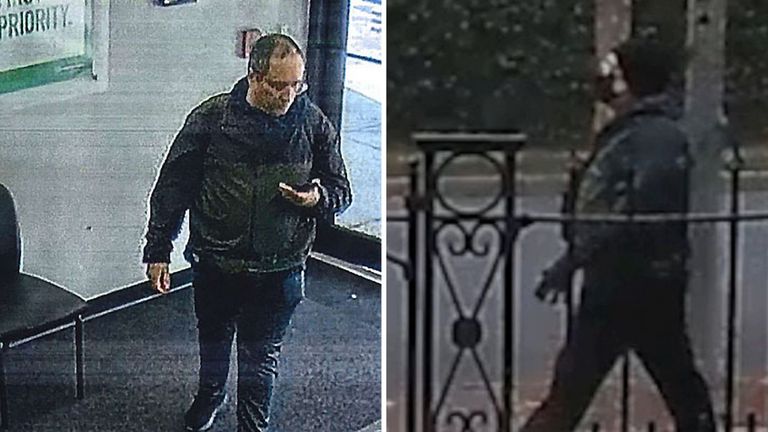
The tragic shooting at Brown University on December 13, 2025, which claimed the lives of two students and wounded nine others was quickly linked by authorities to the December 15 murder of MIT physics professor Nuno F.G. Loureiro at his home in Brookline, Massachusetts. Do the recent developments suggest a purposeful psyop, one designed to escalate societal rifts and shift focus away from the actual orchestrators?
The alleged suspect, 48-year-old Portuguese national Claudio Manuel Neves Valente, a former Brown graduate student who had been classmates with Loureiro decades earlier in Portugal was found dead on December 18 in a Salem, New Hampshire, storage unit he had entered days before. An autopsy confirmed a self-inflicted gunshot wound, with his death estimated as December 16.
Valente’s death ultimately ended the interstate manhunt overnight. Many argue that the resolution wrapped everything up far too quickly, neatly, fueling questions about any hidden motives and possibilities that he did not act entirely alone.
He had no criminal history, no manifesto, and no publicly confirmed motive despite the strikingly targeted nature of the attacks. A physics engineering alumnus from Portugal’s Instituto Superior Técnico (IST), he briefly attended Brown from 2000 to 2001 before withdrawing without a degree. He later gained U.S. permanent residency in 2017 through the diversity visa lottery and lived in Miami. The only apparent link to Loureiro was their overlapping time as classmates at IST in the 1990s.
The digital trail leading to Valente’s identification was as convenient as a scripted television drama. A Reddit tip from an anonymous user known only as “John” provided critical details that combined with surveillance footage and license-plate readers, quickly named the suspect. Law enforcement hailed the tip as the breakthrough that broke the case wide open, yet the swiftness of the connection linking the Brown shooting to the MIT murder within days, invites frank skepticism.
Was the tip real, or a scripted element designed to expedite closure? Valente’s death shortly afterward, with ballistics and DNA tying him to both scenes, ensured no interrogation could ever reveal inconsistencies or external influences.
After an intensive multi-state manhunt, authorities executed a search warrant on December 18, 2025, at an Extra Space Storage facility in Salem, New Hampshire. Valente had rented the unit the previous month, there, they found his body and a firearm.
Many argue that Loureiro, a rising star in plasma physics and nuclear fusion was the real intended victim all along, with the Brown shooting serving merely as a diversion or prelude. Loureiro joined MIT in 2016, earned tenure in 2017, became full professor in 2021, and held the prestigious Herman Feshbach Professor of Physics chair. His theoretical work centered on magnetic reconnection and turbulence in magnetically confined fusion and astrophysical plasmas.
Notably absent from public records is any evidence of political activism or controversial projects on Loureiro’s part, still, given the potential of his research area and MIT’s longstanding government contracts, questions about sensitive implications naturally arise.
One cannot overlook the absence of a confirmed motive for these linked, interstate attacks. The precision with which Valente allegedly targeted a former academic acquaintance at MIT, just days after a mass shooting at his old university, fuels speculation. If he acted alone, why in such a sequence?
The Brown incident feels to some like a diversionary tactic perhaps a smokescreen masking a more personal or hidden agenda. Investigators had to rely heavily on exterior campus footage, nearby residential neighborhood cameras, and off-campus sources to reconstruct the suspect’s movements before, during, and after the attack. Brown University operates an extensive network of over 1,200 security cameras across its campus, clear interior surveillance footage from the building where the shooting occurred was unavailable for key areas involved, including the classroom where the shooting occurred, and surrounding hallways.
Valente’s Portuguese origins and academic overlap with Loureiro at IST have prompted speculation about possible international connections, but, the complete absence of any digital footprint, writings, or statements explaining his actions, despite exhaustive searches, suggests selective suppression. Key indicators support this, including the swift declaration of Valente as the sole perpetrator, followed by his suicide and the immediate closure of the case, a pattern that closely mirrors the classic lone-wolf template seen in numerous high-profile national incidents.
Critics argue that this framing effectively blocks deeper investigations into potential funding sources, handlers, or broader motives. While heavy FBI involvement in the interstate manhunt and evidence processing was entirely routine for a case of this scale, it has nonetheless fueled suspicions that federal resources helped orchestrate a tidy, unquestioned resolution, leaving critical questions unresolved.
Ultimately, the entire account is riddled with what ifs, that defy easy belief. What if a decades-old academic grudge truly resurfaced after all this time? What if that anonymous tip was genuinely just good fortune? What if the suicide was purely coincidental in its timing? And what if the complete absence of motive is simply unexplained? In an age marked by deep institutional distrust, the Brown-MIT case serves as a sobering cautionary tale.
Whether mere coincidence or something more coordinated, its unresolved questions and abrupt resolution invite suspicion beyond blind acceptance of the official account. Until an independent investigation closes the gaps, the possibility of manipulation will continue to cast doubt over what should have been an unambiguous tragedy.

