

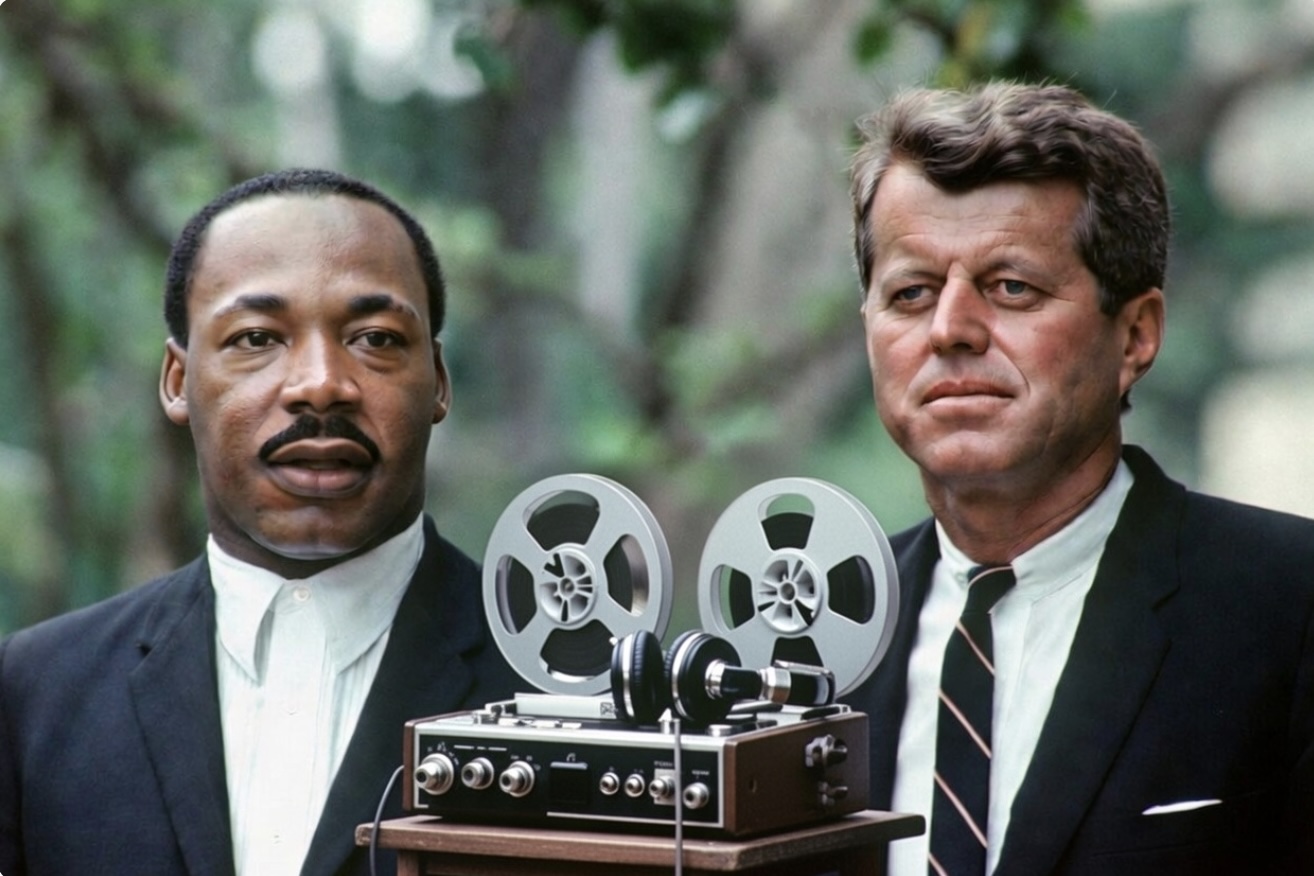
Today is Martin Luther King Jr. Day, a federal holiday observed each year on the third Monday of January. The holiday was signed into law by President Ronald Reagan in 1983 after years of public pressure and national debate. It was created to honor Dr. King’s life, his leadership in the civil rights movement, and the enduring moral challenge he posed to a nation that claimed liberty while tolerating institutional injustice.
And this raises an uncomfortable but essential question: Why do we celebrate the life of a man the FBI tried to destroy? Why does the government now hold ceremonies, speeches, and official tributes for a leader it once treated like a subversive enemy? The answer is simple. Because during the long arc of history people eventually recognize what the powerful tried to suppress: that King was right, and that the state’s war on him was not a defense of America, but an indictment of it.
Martin Luther King Jr. was born on January 15, 1929, in Atlanta, Georgia, into a devout and disciplined Baptist family that prized faith, education, and public service. His father, Martin Luther King Sr., was a prominent pastor at Ebenezer Baptist Church, and his mother, Alberta Williams King, was a teacher and church musician who helped shape her son’s early moral seriousness and intellectual ambition. From an early age, King demonstrated exceptional gifts as a speaker, a student, and a man drawn to purpose larger than himself.
King attended Morehouse College in Atlanta, where he was influenced by the institution’s tradition of Black excellence and leadership. He later studied theology at Crozer Theological Seminary in Pennsylvania and ultimately earned his doctorate at Boston University, where he refined his philosophy, sharpened his rhetoric, and anchored his worldview in an uncompromising belief that moral truth and civic justice were inseparable.
While in Boston, King met Coretta Scott, an intelligent, accomplished woman whose strength and dignity would become essential to his life and mission. They married in 1953 and together raised four children: Yolanda, Martin Luther King III, Dexter, and Bernice. Coretta was never merely the wife behind the curtain. She was a partner in the movement, an advocate in her own right, and later, the guardian of King’s legacy after his assassination.
King rose to national prominence during the Montgomery Bus Boycott in 1955 propelled by the righteous fury of a people who refused to live forever on their knees. In speech after speech, march after march, and sermon after sermon, King brought an unmatched moral clarity to the civil rights struggle. He did not speak like a bureaucrat. He spoke like a prophet. He did not defy law enforcement. He protested peacefully. He never started a riot. Instead, he framed civil rights not as a partisan negotiation but as a sacred American debt long overdue.
But what many Americans still do not fully understand is that King was not merely opposed by regional segregationists and local political machines. He was targeted and pursued by the most powerful surveillance apparatus in the United States government.
King was harassed by the FBI, monitored relentlessly, and subjected to intimidation tactics that, in any honest era, would be recognized as state misconduct of the highest order. Under J. Edgar Hoover, the FBI treated King not as a citizen exercising constitutional rights, but as an enemy to be neutralized. Hoover despised King, feared his influence, and was determined to discredit him through private recordings, leaks, pressure campaigns, and psychological warfare.
And here is the part the history books often whisper when they should speak plainly: Attorney General Robert F. Kennedy approved wiretaps on King, after Hoover demanded them. Kennedy, under the pretext of national security and communist infiltration fears, signed off on surveillance that would become a stain on the government’s record. The justifications shifted, the rationalizations multiplied, but the real purpose became obvious: to collect dirt, to gain leverage, to publicize his infidelities, and to crush a leader whose moral authority could not be defeated in open debate.
Given the crucial role that King played in John F. Kennedy’s razor thin victory over vice president Richard Nixon after King was arrested in Birmingham, Alabama and JFK publicly criticized the arrest and privately pressured the judge and Governor to release King while Nixon essentially did nothing RFK’s approval of the wire taps on King remain a conundrum,
The King they could not beat in the public square became the King they tried to destroy in private. It is a familiar formula in American politics, one that has repeated itself across decades whenever the permanent bureaucracy believes it can decide which voices are permissible and which must be silenced.
King was a towering figure, a man of courage and conviction, but also a human being living under crushing stress, unimaginable pressure, and constant threats. The state’s campaign against him was ruthless, invasive, and calculated to break him. The FBI did not monitor him to protect him. They monitored him to control him. The FBI learned that King was having extra marital affairs with as many as 40 women during his civil rights Crusade. King was picked up on FBI wire taps bragging about his oral sex technique with women.
Yet King endured. He continued to speak. He continued to march. He continued to confront the comfortable lies of the establishment with truths that unsettled those who profited from injustice. His famous words about brotherhood, equality, and dignity were not poetic ornaments. They were declarations of war against moral cowardice.
When King was assassinated on April 4, 1968 America did not merely lose a civil rights leader. It lost one of its most potent moral forces. His death was not the end of the struggle he championed, but it was a brutal reminder that courage in this country has often been met with bullets, not medals.
And even now, decades later, the life of Martin Luther King Jr. remains a mirror held up to America. It reflects both our capacity for redemption and our talent for hypocrisy. It reminds us that real reform is not handed down by benevolent institutions. It is demanded by brave individuals who refuse to accept that injustice is inevitable.
King’s legacy survives because it is larger than the smears, larger than the surveillance, larger than the cowardice of those who wanted him ruined. History ultimately belongs to those who tell the truth. And Martin Luther King Jr. told the truth so powerfully that the most entrenched forces in the country treated him as a threat simply for insisting that America live up to its own founding promises.

